We would like to remind everyone to please use trusted sources only, for more information on COVID-19, healthcare and homecare workers information, mental health and the virus, government measures and employment please take a look at some of the below websites:
We have lots of job vacancies available nationwide, please have a look at the jobs section on our website for something near you. You can also call our homecare team on 1800 400 900 and follow us on Facebook https://www.facebook.com/myhomecare/
With a new generation of employees now
hitting the workforce, the traditional way of running businesses has changed.
One example is with working hours.
Flexible working was introduced as a way to encourage a healthy work-life
balance.
Over the last few years, the number of
people working in part-time employment has increased. As well as those
returning from starting a family and the effects of the gig economy, it’s also
due to those struggling to maintain a healthy balance between their work and
personal lives.
In this piece, we’ll define flexible
working and the rules surrounding it. We’ll also explore the importance of this
type of work for carers.
What is flexible working?
It’s a work pattern adapted to suit
both you and your employees. There are different types of flexible working
arrangements, examples include:
Changing to
part-time hours.
Changing working
days.
Changing
full-time working hours.
Working your
normal weekly hours in fewer days (compressed hours).
Working from home
part or fulltime (homeworking).
Retain two people
for the same position on a part-time basis (job sharing).
Work usually
rotating but specified hours (shift working).
Using
technological advances to work from remote locations (teleworking).
Calculating
working hours based on annually instead of weekly (annualised hours).
Unlike the United Kingdom, there’s no
legal right to flexible working. However, since the introduction of the Code of Practice on Access to Part-time Work in 2006, it’s now become a best practice for
employers have policies on improving access to part-time work.
Employees can make requests for
flexible working. As an employer, you should have a procedure in place that
allows for a discussion between yourself and the employee before making a
decision. Remember to consider:
The employee’s
personal needs.
The staffing
needs for the company.
The implications
to the business and their co-workers.
To avoid claims of discrimination, you
must consider all request for flexible working fairly and in accordance with
the employment equality legislation.
The importance of flexible working for carers
Accommodating flexible working
requests can be a challenge especially for those in the care sector.
The work itself is one that can do
with allowances for flexible working. It involves rotating working hours,
usually long travel times and unsociable hours.
However, from the point of view of the
employer, it may be tricky, as you’ll need to ensure there’s sufficient staff
to cover at all times.
And there are benefits for employers
and employees.
For employers
Boost employee
morale.
Reduce
absenteeism.
Reduce employee
turnover.
Improve
wellbeing.
Enhance company
image as a family-friendly employer.
Increase
productivity.
For employees
Better work/life
balance to meet personal and family needs.
Less stress.
Increased job
satisfaction.
Reduced expenses
and time spent commuting.
More control over
working hours and environment.
Final note
Remember,
while it may be a challenge to create a flexible working policy, the rewards
are well worth it. As well as easing your staff’s work/life balance, you can
also reduce business costs, improve output and ensure the loyalty of your
staff.
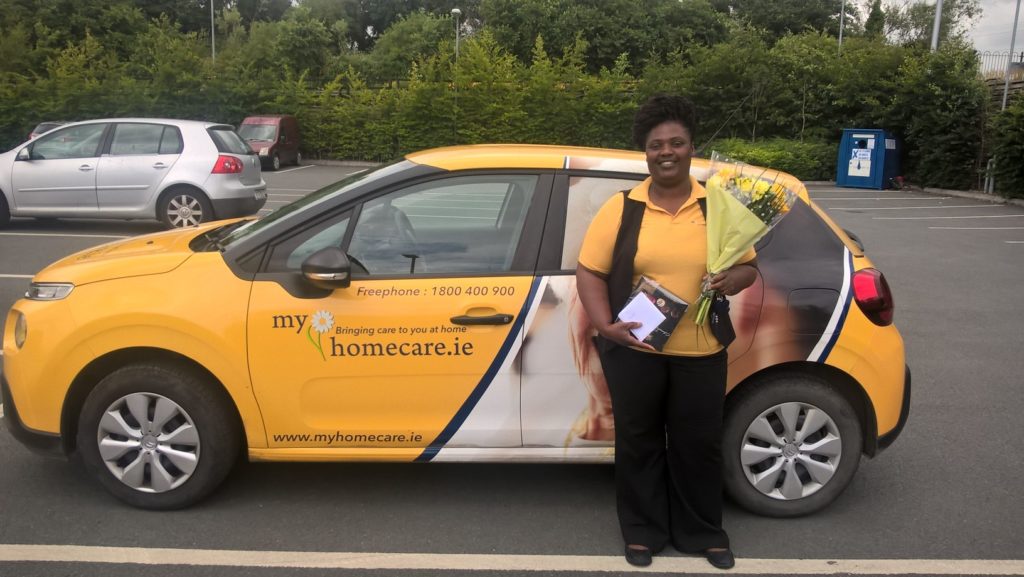
Huge Congratulations to our ‘Carer of the Quarter’ Jennifer Twum!
Here at www.myhomecare.ie we believe that hard work deserves recognition. We have an exceptional team that works with us both internally and externally. They are hard working, reliable and willing to go above and beyond to ensure our care recipients and families receive the best quality of care.
As always, our homecare team had a difficult decision in choosing just one! Jennifer stood out because of her dedication towards her work and her caring nature towards her clients. Well done Jennifer. Thank you from everyone at Myhomecare.ie.
Pictured: Jennifer being presented with flowers as a token of our appreciation.
Myhomecare are taking part in the ‘Paint it Pink’ campaign.
Breast cancer is the second most common cancer affecting women in Ireland. 3,100 women are diagnosed with breast cancer each year.
October is breast cancer awareness month and on Thursday 4th October our nationwide offices in Dundalk, Dublin, Cork and Galway wore pink to work to raise awareness about breast cancer in Ireland. Funds raised will be going towards our local hospices for cancer patients.
#PaintItPink
If you wish to donate to the Irish Cancer Society , please donate via this link: